
Walking into an unfamiliar classroom taught me to read status, energy and resistance quickly. Those same skills are valuable for actors entering a scene.
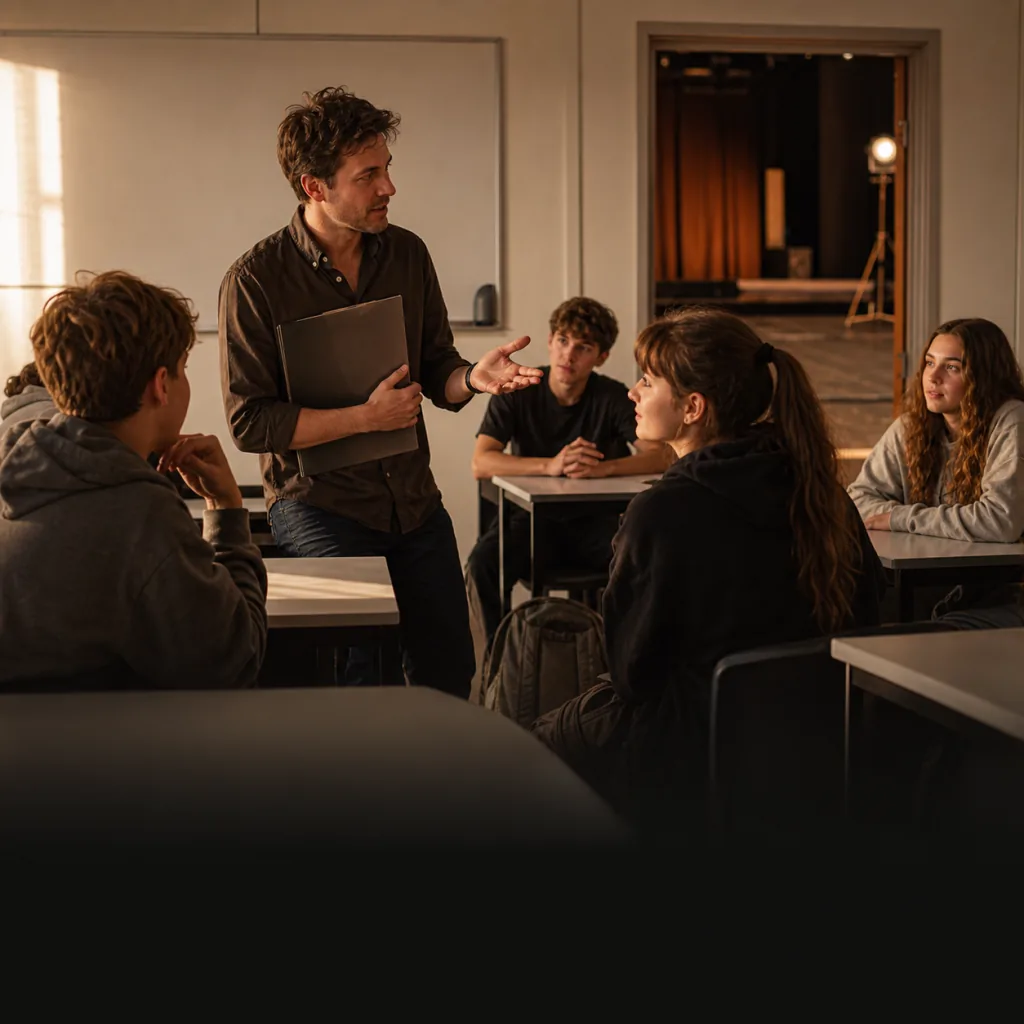
Walking into an unfamiliar classroom as an emergency teacher is a strange kind of entrance. Thirty people have already formed a world before you arrive. They know the rules, alliances, jokes and pressure points. You are the new element, and everyone is reading you while you read them.
That experience sharpened something I now use constantly as an actor: the ability to notice the room before trying to control it.
Every room already has a scene in progress
Actors sometimes enter as though the scene begins with their first line. In life, it rarely does. Other people have been thinking, arguing, waiting or hiding something before you appear.
A classroom makes that obvious. One student is trying to entertain the group. Another wants the day to pass unnoticed. Somebody is testing the boundary, and somebody else is watching to see whether you notice.
A scripted scene contains the same invisible structure. Status, alliances and unfinished business are already active.
Read behaviour before assigning meaning
When pressure is high, it is easy to make a quick judgement. The loud person is "difficult." The quiet person is "disengaged." An actor can make the same mistake with a character and reduce them to a label.
Try recording facts first. Who interrupts whom? Who avoids eye contact? Who changes posture when a particular person speaks? Behaviour gives you playable information. Labels close the investigation.
Adjustment is not surrender
Teaching also taught me that a plan can be good and still be wrong for the room. You may need to change the pace, simplify the instruction or address the thing everyone is pretending not to notice.
On set, directors make adjustments for the same reason. A note is not a verdict on your ability. It is information about what the scene needs now.
Try this: enter the room late
Use a scene with at least two other characters, even if friends read the parts from chairs.
- Ask the other performers to improvise for one minute before you enter. They should choose a shared problem but not tell you what it is.
- Enter without speaking for the first ten seconds.
- Notice who has status, who wants your support and what subject seems dangerous.
- Begin your scripted scene while allowing those observations to affect your behaviour.
- Repeat with a different improvised situation.
The goal is not to guess the secret correctly. It is to arrive receptive instead of imposing a pre-planned tone.
Use the whole room
A strong actor notices more than the person delivering the line. Space, objects, silence and the behaviour of other people all carry information. That wider attention can reduce self-consciousness because your mind has real work to do.
This is one of the connections between teaching and acting that I value most. Both require preparation, but neither rewards rigid control. You need a plan, then you need to meet the people in front of you.
Carry this into auditions
Before a scene begins, take in one real detail about the space. Feel the floor, hear the air conditioner or notice the distance to your reader. Then place yourself in the imaginary circumstances.
You are not using the room to calm down. You are reminding yourself that you are in contact with something beyond your own thoughts.
My second article on this subject, How Emergency Teaching Made Me a Better Actor, focuses on interruption and recovery. The About Paul Moore page gives more context on how teaching became part of my acting practice.
Related Actors Insights
Continue learning
Questions or corrections? Contact Moore Acting Instinct.