
Stage presence is not a special personality trait. It grows when an actor gives full attention to the space, the other person and the next necessary action.
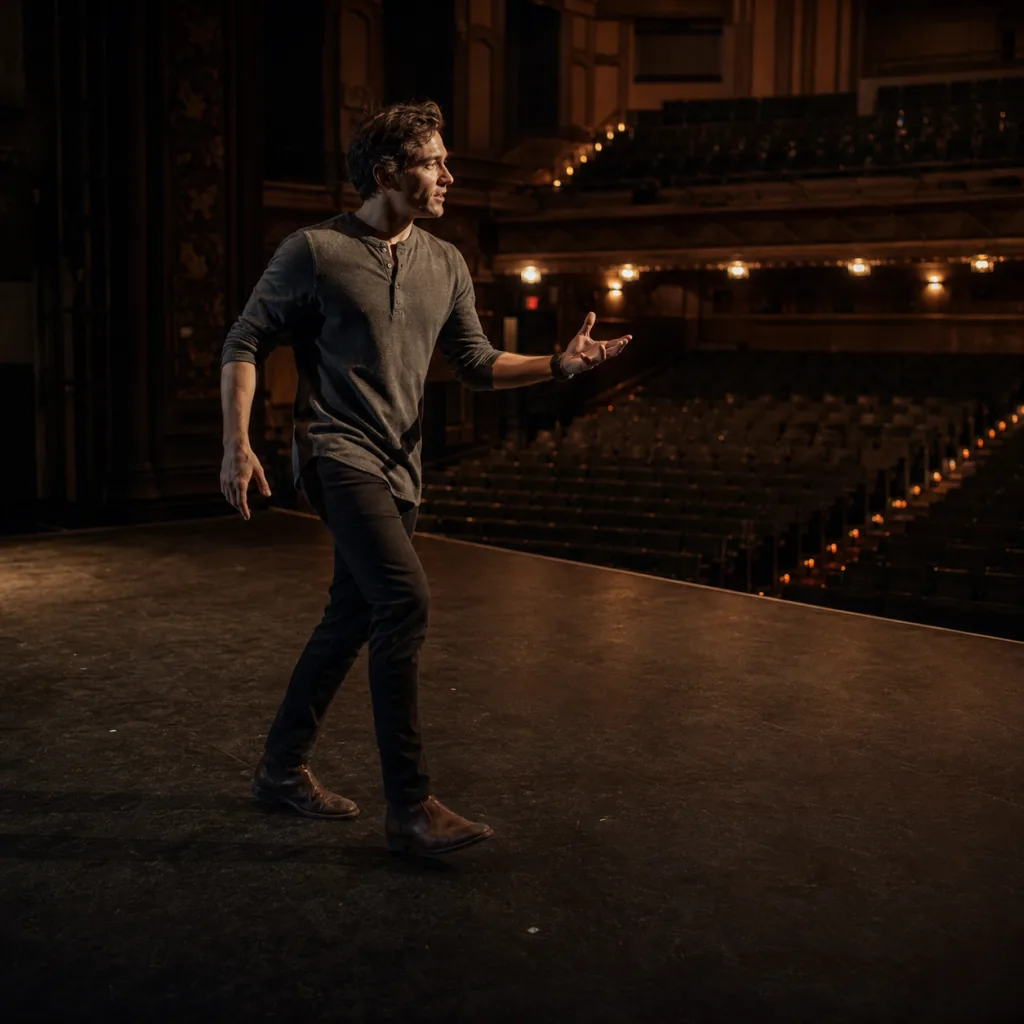
Stage presence is often described as though some people are born with a larger supply of it. They walk into a room, everybody looks up, and the rest of us are meant to wonder what secret quality they possess.
I see it differently. Presence is not the amount of personality you project. It is the quality of attention you bring into the space.
An actor who is genuinely affected by the room, the other person and the problem in front of them can hold an audience without trying to look important.
The audience follows attention
When your attention is scattered, the audience has nowhere to settle. You may be thinking about your lines, your posture, the teacher, the lighting and whether you appear confident. All of that activity can make the performance feel oddly empty.
Specific attention creates a path. We see what matters to you, even when we do not yet know why.
On stage, this needs enough physical clarity to travel through a larger space. That does not mean turning every thought into a gesture. It means allowing your body, eyeline and timing to be organised by something real.
Use the whole room
Many actors behave as though the scene begins at their own skin. The set, furniture, entrances and distance between people become decoration.
Try asking:
- Which part of the room feels safest?
- What object do I want to keep between us?
- Where could the other person leave?
- What am I trying not to look at?
- How does the distance change when the relationship changes?
The room can tell the story before the dialogue does.
Try this: the invisible thread
You need a scene partner and an open room.
- Stand at opposite ends of the space.
- Imagine a thread joining the centre of your chest to the other person.
- Begin a simple scene without deciding where you will move.
- Every time the relationship improves, allow the thread to shorten. Every time trust drops, allow it to lengthen.
- Do the scene again, but reverse the rule. Move closer when threatened and farther away when you want connection.
- Discuss which version produced the more interesting behaviour.
The exercise is not about creating pretty blocking. It makes distance part of the acting choice.
Record it from the back of the room. Watch without sound and ask whether the relationship is readable through space alone.
Stillness must have pressure behind it
Stillness can be powerful, but only when the actor is resisting, waiting, deciding or receiving. Standing motionless because you have been told to do less is not the same thing.
Give stillness a reason. Perhaps moving would reveal fear. Perhaps you are waiting for the other person to apologise. Perhaps you believe the first person who moves loses.
Then the stillness has tension without extra performance.
Voice follows intention
Actors sometimes try to create presence by adding volume. A strong voice matters on stage, but volume without a target becomes noise.
Send the thought to someone. Know why they must hear it. Let breath, pace and emphasis serve that need.
In my acting classes, I would rather hear a quieter line that changes another person than a powerful speech delivered at the room.
Presence is participation
The actors I remember are not always the most flamboyant. They are the ones who seem fully involved. They make the space matter, they notice change and they allow the audience to watch them solve something.
That is trainable. You do not need to become louder or more impressive. You need to place your attention somewhere worth following.
For the screen version of this work, read How to Look Present on Camera Without Doing More. You can also explore my acting classes and courses.
Related Actors Insights
Continue learning
Questions or corrections? Contact Moore Acting Instinct.