
Filling a stage comes from clear thought, supported speech, spatial commitment and a relationship that reaches beyond your own performance.
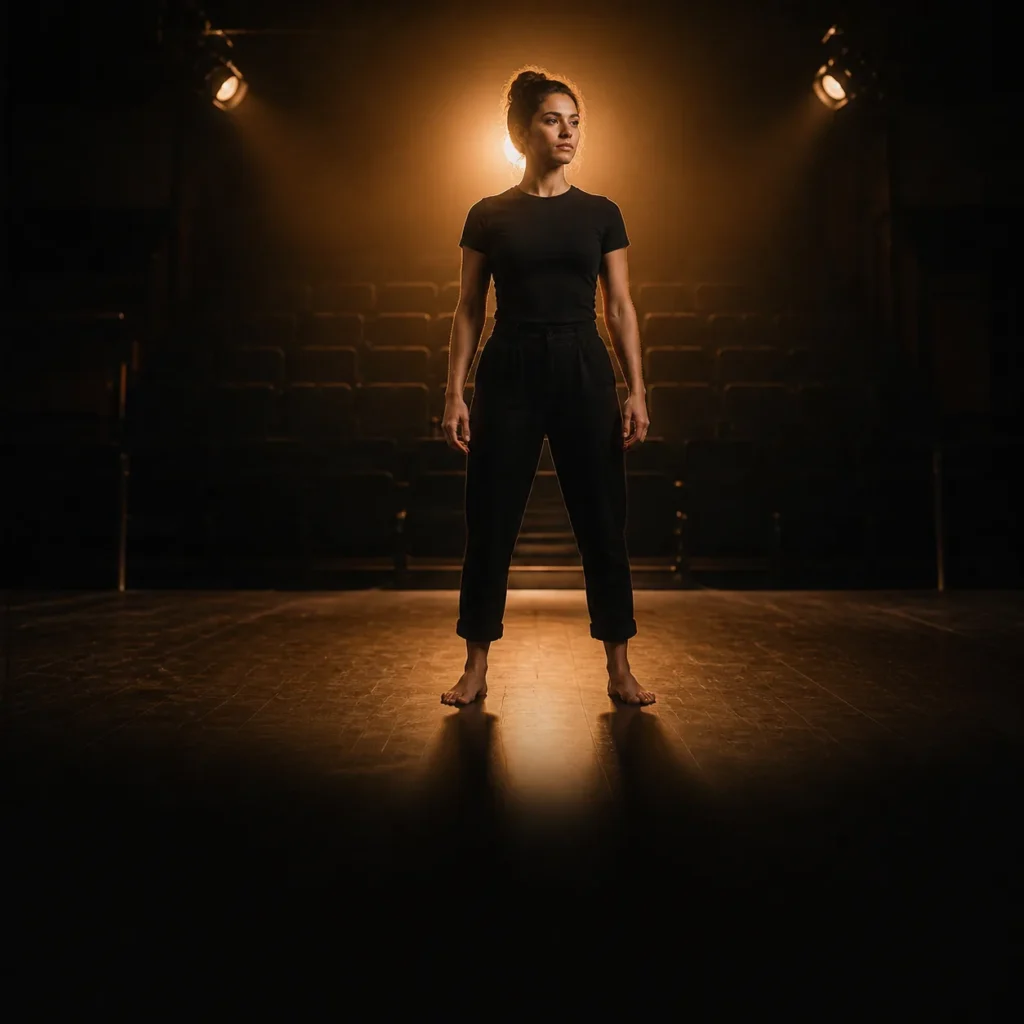
A larger space asks for clarity, but clarity is not the same as force.
When actors try to fill a stage, they may push the voice, widen every gesture and hold the body in a permanent state of importance. The result can become tiring to perform and difficult to believe.
The stage needs your thought, voice and action to travel. It does not need every moment enlarged equally.
Send the thought before the sound
Projection is not shouting at the back wall. Know who needs to hear the line and why.
A supported voice carries more easily when the thought has a target. If you are warning one person while trying not to alert another, the vocal choice becomes specific. If you simply decide to be loud, the relationship disappears.
Voice training with a qualified teacher can help with breath, resonance and safe projection. Pain or persistent strain is not a normal price of stage acting.
Complete the physical action
Small gestures can read in a theatre when they are clear. Large gestures can disappear when they are vague.
If you decide to cross the room, know what you are going to do when you arrive. If you pick up an object, let it affect the scene. Half-finished movement often looks like an actor filling time.
Use contrast
A performance with only one size becomes visually quiet, even when it is loud. Contrast gives the audience information.
Fast movement beside stillness, public speech beside private confession, distance beside sudden closeness and control beside one loss of control can all create scale.
Do not plan contrast as decoration. Let the circumstances cause it.
Try this: the shrinking theatre
Use a short scene in the largest room available.
- Perform it for an imaginary audience at the far end of the room.
- Repeat it for an audience halfway towards you.
- Repeat it for one person sitting two metres away.
- Repeat it in close-up on a phone camera.
- Return to the large-room version, keeping the most truthful details from the close-up.
Ask a partner to stand at the back and report what remained clear: words, relationship, changes of thought and physical actions.
The aim is not to make all four versions identical. It is to discover what needs scale and what only needs precision.
Let the audience come to you
Actors sometimes work so hard to reach an audience that they leave no space for the audience to become curious.
A secret, a withheld reaction or a precise still moment can draw attention across a large room. The audience leans in because something matters and is not being fully explained.
Know the architecture
Entrances, levels, furniture and sightlines influence performance. Walk the space before the work begins. Find where your body is hidden, where sound changes and how long a cross actually takes.
Stagecraft is not separate from acting. It helps your choices arrive intact.
Keep the other actor in the room
The fastest way to lose stage presence is to begin presenting the scene to the audience instead of affecting the person beside you.
Even when a production uses direct address, know when you are speaking with the audience and when you are using them for a particular purpose.
Presence grows from commitment to the event, not from displaying performance energy.
Read Stage Presence Is About Where Your Attention Goes for spatial work, or visit the acting classes and courses page for current training information.
Related Actors Insights
Continue learning
Questions or corrections? Contact Moore Acting Instinct.