
Trying to eliminate nerves can make an audition harder. A better approach is to direct that energy towards a physical task, a relationship and a clear objective.
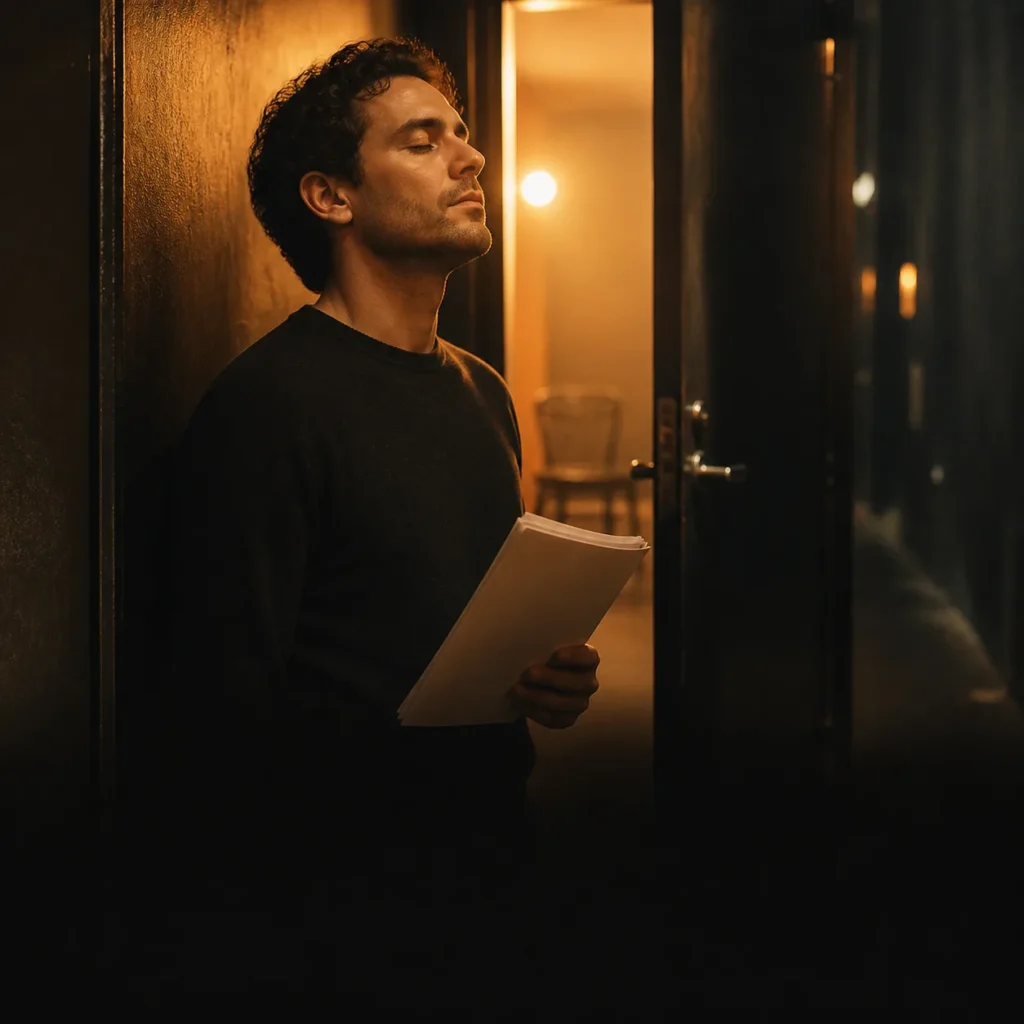
I know what it is like to feel your body turn against you before an audition. My own history with panic made me very good at noticing every heartbeat, every bead of sweat and every thought that said, "Get out."
For years I treated those sensations as proof that I was not ready. Eventually I discovered that fighting them gave them more attention. The shift was not learning to feel nothing. It was giving the energy somewhere useful to go.
Nerves are not a performance note
A racing heart does not tell you how to play the scene. It tells you that the moment matters to you.
Problems begin when the actor turns inward and starts monitoring the symptoms. The scene partner disappears. The objective disappears. The audition becomes a live broadcast of "How am I doing?"
Your job is not to win an argument with your nervous system. Your job is to reconnect with the imaginary circumstances.
Give the energy three jobs
A physical job
Choose one simple action that belongs in the scene. Fold a letter, clean a glass, straighten a sleeve or prevent somebody from leaving. The action should support the story rather than distract from it.
A relationship job
Complete this sentence: "I need this person to see me as…" Perhaps you need them to see you as capable, harmless, desirable or impossible to ignore. This gives your attention a human target.
A thought job
Choose the thought that exists just before the first line. Not an emotion, and not an instruction to act well. A real thought might be, "They already know," or "This is my last chance to ask."
Try this: the adrenaline assignment
Use a scene of no more than one page.
- Record a first take exactly as you normally would.
- Before the second take, write down one physical job, one relationship job and one first thought.
- Let the nerves remain. Do not take extra time trying to settle them.
- Start the take while doing the physical action.
- Watch both versions and compare where your attention appears to be.
In the stronger take, you may still see tension. That is fine. The useful question is whether the tension belongs to a person pursuing something, rather than an actor asking permission to be there.
What I learned from the audition that changed my career
Before I auditioned for Winners & Losers, I stopped begging myself to calm down. My version was less polite. I essentially invited the fear to arrive and decided I would act anyway.
That did not make me superhuman. It interrupted the old pattern of waiting to feel safe before taking part. I could finally place my attention on the work.
I still use that principle as an actor and acting coach. Readiness is not the absence of feeling. Readiness is having a task that matters more than the feeling.
After the audition
Do not perform an autopsy in the car park. Write down one technical note while the memory is fresh, then return to your day. Casting involves many factors that are outside your control.
You can control whether you prepared the relationship, understood the scene, submitted professionally and made a specific offer. That is enough work for one audition.
For a different approach to pressure, read Acting With Anxiety: You Do Not Need to Feel Calm First and The Best Audition Reset Is Curiosity, Not Confidence.
Related Actors Insights
Continue learning
Questions or corrections? Contact Moore Acting Instinct.